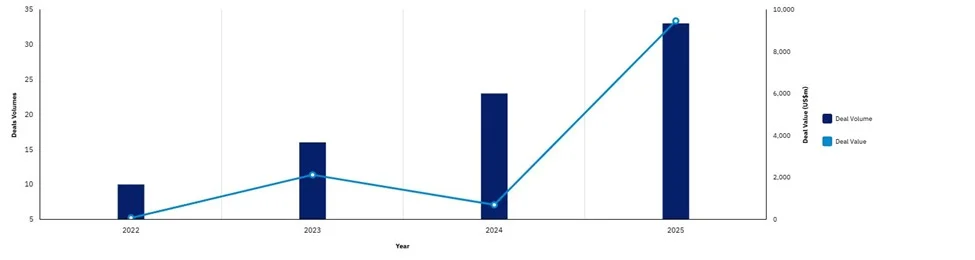
The most visible shift toward capability-buying is in AI. Since 2022, M& A dealsinvolving artificial intelligence have increased in volume and value significantly (Fig. 1), as leading companies embed AI within their existing infrastructure,particularly in drug discovery and development.
To expand their early pipeline, many large manufacturers areturning to partnerships with AI-native technology companies. Merck KGaArecently expanded its collaboration with Valo Health to use AI and patient datasets within a research engine focused primarily on discovering new treatments for Parkinson’s disease.1 This partnership pairs Merck’srobust drug development capabilities with a human causal biology platformcomprised of patient records and biobank samples to identify specific patientphenotypes and new target points for therapeutic intervention. BoehringerIngelheim’s collaboration with Variant Bio follows the same logic.2While kidney disease is the entry point, the asset is population-scale genetic data paired with an AI discovery system that can be redeployed as prioritiesshift to reduce the time required to move from genetic association to validated therapeutic hypothesis.
This mindset also extends into molecule design. Recent studies have demonstrated that deep learning approaches in molecular encoding and validation can produce molecules that are both novel and applicable in the real world.3 Large manufacturers are also employing this approach in the real world, evident in Takeda’s repeated collaboration with Nabla Bio to leverage generative AI in molecule design for multiple targets in parallel.4
Critically, these platforms depend on proprietary data, and manufacturers are investing accordingly. GSK’s partnership with Helix secures ongoing access to large-scale genomic and longitudinal datasets, turning human data into a reusable corporate asset rather than a one-time input.5
Companies are also investing in platforms, from deliverymechanisms to new modalities, that can be translated across assets, particularly where control of underlying technology creates durable advantage.
.png)
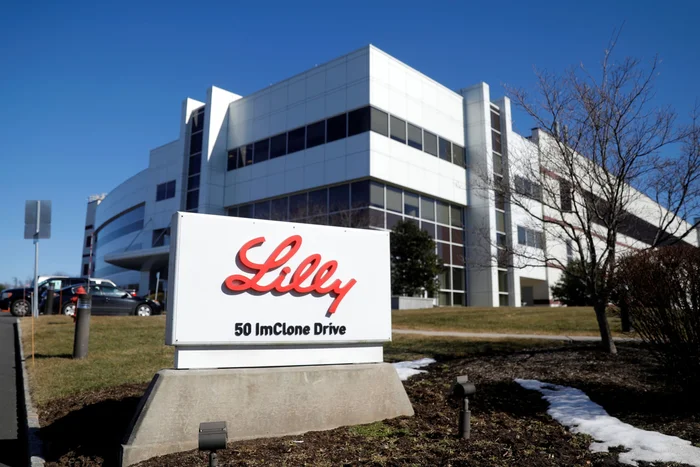
Eli Lilly's obesity partnerships, including NimbusTherapeutics, are structured around oral and metabolic platforms, not single assets. Notably, this latest partnership focuses on an oral modality fortraditionally injectable obesity treatments, overcoming a significant barrier for multiple assets in the heavily competitive space.6
Delivery platforms are being treated similarly. Roche’s collaboration with Manifold Bio focuses on brain-shuttle technology to cross the blood–brain barrier. This is a reusable solution to a persistent bottleneck, enabling multiple future CNS programs rather than a single bet.7
Capability buying is not limited to R& D. Manufacturing and supply chain control are increasingly viewed as strategic assets, shaped bygeopolitics, trade policy, and speed requirements.
As tariffs have increased the cost of international manufacturing and supply chains, some large manufacturers are bolstering their end-to-end domestic footprint. Samsung Biologics' acquisition of GSK'sRockville facility establishes its first U.S. manufacturing footprint,providing faster client access and reinforcing capacity as competitive advantage.8 Moderna's decision to onshore fill–finish manufacturingcompletes its end-to-end domestic mRNA network, giving it full value chain control and compressing development-to-commercial timelines.9
.png)
Other manufacturers have taken the opposite approach, expanding capabilities outside of the US. Roche’s expanded agreement with Freenome to scale cancer screening outside the U.S. reflects investment in diagnostics and early detection infrastructure—reshaping demand upstream of treatment.10 Ultimately, control over manufacturing and infrastructure compresses timelines, reduces dependency, and creates resilience that compounds across programs, regardless of their geographic location.
These moves reveal common logic:across discovery, modality development, and manufacturing, leading companies are choosing repeatable systems over individual outputs.
Portfolio strategy must account for platform leverage. A capability deployed across ten programs creates fundamentally different value than ten standalone assets.
R&D strategy needs a capabilities lens. Which bottlenecks, if solved once, unlock multiple programs?
Manufacturing is now strategic, not operational. Scale, geography, and operational independence constitute a competitive moat.
The risk of inaction is subtle but significant. Companies that continue to rely primarily on late-stage asset acquisition may find themselves paying more for less differentiation, while competitors quietly build engines that outlearn and outscale them.
The defining strategic question is no longer “What should we buy next?” but “What capabilities do we want to still be using five programs from now?”[MB1]


Get expert analysis, industry trends, and exclusive updates delivered straight to your inbox. Stay ahead of the curve with valuable insights that drive success.